
Trends | Adel & Link Public Relations
32
wp-singular,page-template,page-template-full_width,page-template-full_width-php,page,page-id-32,wp-theme-bridge,wp-child-theme-bridge-child,bridge-core-2.1.3,,qode-title-hidden,qode_grid_1400,qode-child-theme-ver-1.0.0,qode-theme-ver-20.0,qode-theme-bridge,disabled_footer_bottom,qode_header_in_grid,wpb-js-composer js-comp-ver-9.0.1,vc_responsive

Trends

Trends

Imagining the future

At Adel & Link we’re always on the hunt for the latest trends, which also provide us with material for our Stories for Now and Next. On a daily basis, we observe how our society is changing, what people are talking about and what we can do to make a difference. We immortalise the most important trends in many different ways – from stickers to trend books to socks – and send them out into the world to share them with our network. After that, we present the most important trends at our annual Trendvernissage.

Our trends 2026

Our trends 2026

Humanized AI

Whether it’s about dinner, relationship crises or everyday work: nowadays, we ask AI for advice. While companies and media houses are now investing in GEO, the intelligent assistant has already become the preferred buddy in all situations. In England, one-fifth of young people between the ages of 11 and 18 prefer to turn to a chatbot rather than another person—because it is easier than talking to a real human being. No surprise: AI is getting to know us inside out, acting like a nice, patient friend. Quite a few people seek psychological advice from Chatty and others, sometimes with alarming consequences.

Read more

Despite all the advantages, we must not forget that AI-generated answers are not necessarily the truth, but probabilities wrapped in words. However, the more human they sound, the easier it is to be fooled. Experts emphasise that the systems merely mimic consciousness and create irrational closeness. What does this mean for us? It would be unrealistic not to work with AI and go without the convenience of instant answers. But we have to find out for ourselves whether they are the right ones.

Life Unplugged

Constantly on your smartphone? It’s not just Gen Z that’s had enough. Hardly surprising, as dependency is increasing and mental health is suffering. There is a growing desire to experience the world with all our senses again, rather than sharing it with mobile devices. Younger people in particular are choosing digital detox over doomscrolling. Sports clubs are celebrating record membership numbers, and people are bringing “analogue bags” with knitting supplies, pens and a notebook everywhere. Is this the antidote to our digitalised life or simply a logical consequence of it?

Read more

Let’s be honest: in the long run, hyper-accelerated content consumption is simply exhausting. Experiencing more real things again, finding peace and quiet, and doing something with your hands sounds wonderfully refreshing. More so, being able to pass time offline is becoming a priceless commodity. Bridging waiting times without a mobile phone in your hand is becoming the ultimate challenge. With wonderful consequences: idle time allows the brain to make new connections, develop ideas and find creative solutions to problems.

Data Diet

The hunger for digital resources is growing: in autumn 2025 alone, ChatGPT was used by around 800 million people globally every week. An estimated 100 trillion gigabytes of documents, emails and photos are stored in cloud data centres around the world. Particularly problematic are the water-powered cooling of data centres and the enormous power requirements of AI models. Despite best efforts, it is not possible to calculate definitively how high the resource consumption for training and use actually is. However, by 2030, data centres worldwide could consume almost twice as much electricity as Germany currently uses annually.

Read more

We are still in the very early stages of using generative AI. This is another reason why the pressure to innovate must increase for forward-looking concepts such as regional energy centres or waste heat recovery. The aim will be to reduce the ecological footprint along the entire value chain. We as users should also ask ourselves how we can make AI conversations and data usage not only more efficient, but also more resource-saving. On Digital Cleanup Day on 21 March 2026, we want to set an example and have a big digital clear-out. Just join in!

Brave New Work

Not a day goes by without news about the impact of AI on the world of work. The discussion focuses on efficiency and potential, but also on dwindling entry-level jobs and massive job cuts. In Europe alone, AI and automation will force up to twelve million people to reorient themselves professionally. This change raises not only the question of how and with what we will earn our living in the future, but also what work will mean.

Read more

Brave New Work encourages us to ask bold questions and find new answers. What skills do we humans need in a post-work-centred world? And how can we best help shape this? As knowledge workers, we already sense what data expert Dr Katharina Schueller says: “It’s no longer about knowledge. It’s about skills and attitude.” Outside of work, topics such as creativity, social participation, education, personal development and community will also become more important—provided there are viable concepts that finance our livelihoods.

Trendvernissage

Trendvernissage

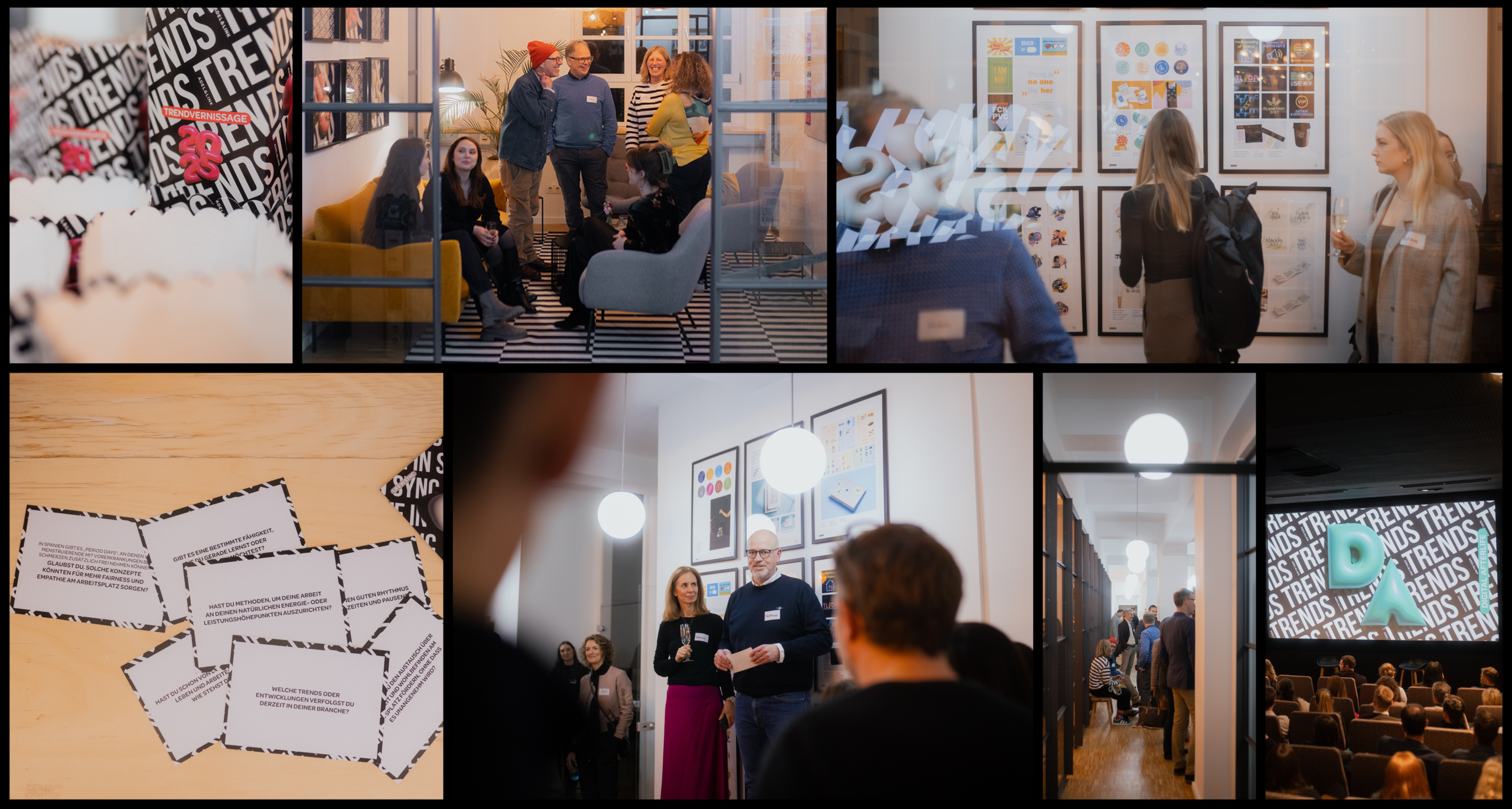
Once a year, we move our desks to the side and create space for the future. Our Trendvernissage brings together exciting topics and creative personalities. It offers an inspiring platform and sparks ideas among start-ups, creatives and communication professionals in the Rhine-Main area.We bring together pioneers, visionaries and sometimes even oddballs, present evolving ideas and show how they will shape the future. And we invite our guests to exchange ideas and soak up inspiration.
Our previous trends

Our
previous
trends